CB Sounddesign
Synthetic impulse responses
Operator's manual · v1.0
Operator's manual · v1.0
CB IR Forge
Impulse responses built from nothing — rooms, plates, springs, digital boxes and things that were never a space at all. You shape the decay, the density and the tone, press build, and get a WAV for any convolution reverb. It is the counterpart to IR Lab: Lab measures real spaces, Forge invents them.
Shape
Length, pre-delay, decay per band
Character
Density, tilt, width, modulation
Export
One WAV, or a batch by seed
Start from a preset
Twelve starting points, from Concert hall to Airless void. Pick the one nearest what you want and adjust — the parameter space is large enough that starting from Custom is slow, and every preset is a legitimate IR on its own.
Twelve starting points, from Concert hall to Airless void. Pick the one nearest what you want and adjust — the parameter space is large enough that starting from Custom is slow, and every preset is a legitimate IR on its own.
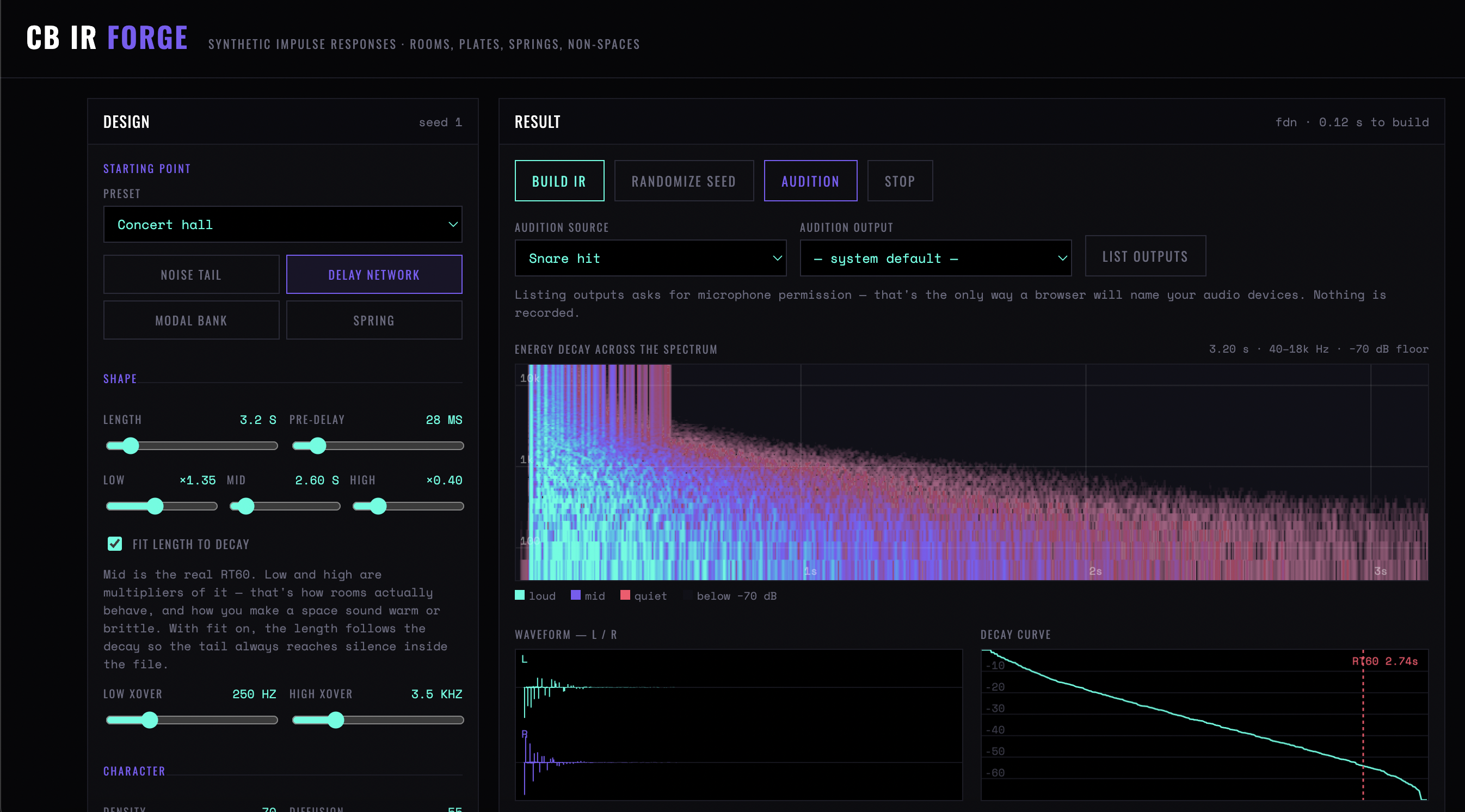
Figure 1 — The design column on the left, the result on the right: build, seed, audition source and output, then the spectral decay view
Chapter one
Starting point
The preset and the engine behind it. The engine is the more consequential of the two.
Preset
Concert hall, dark chamber, small bright room, cathedral, steel plate, spring tank, 80s digital box, drone bloom, metallic resonator, reverse swell, gated slam, airless void, or Custom. Choosing one sets every control below.
Noise tail
A shaped noise decay. The general-purpose engine and the one that sounds most like a room. Start here unless you know you want something else.
Delay network
Discrete taps feeding back. Grainier and more rhythmic; it is how digital boxes of the eighties actually worked, and it is the engine for that sound.
Modal bank
Tuned resonators. Not a room — a pitched object. Use it when you want the reverb to add harmony rather than space.
Spring
A dispersive model. Chirpy, metallic and unmistakable. Barely adjustable by design, because a spring tank is barely adjustable.
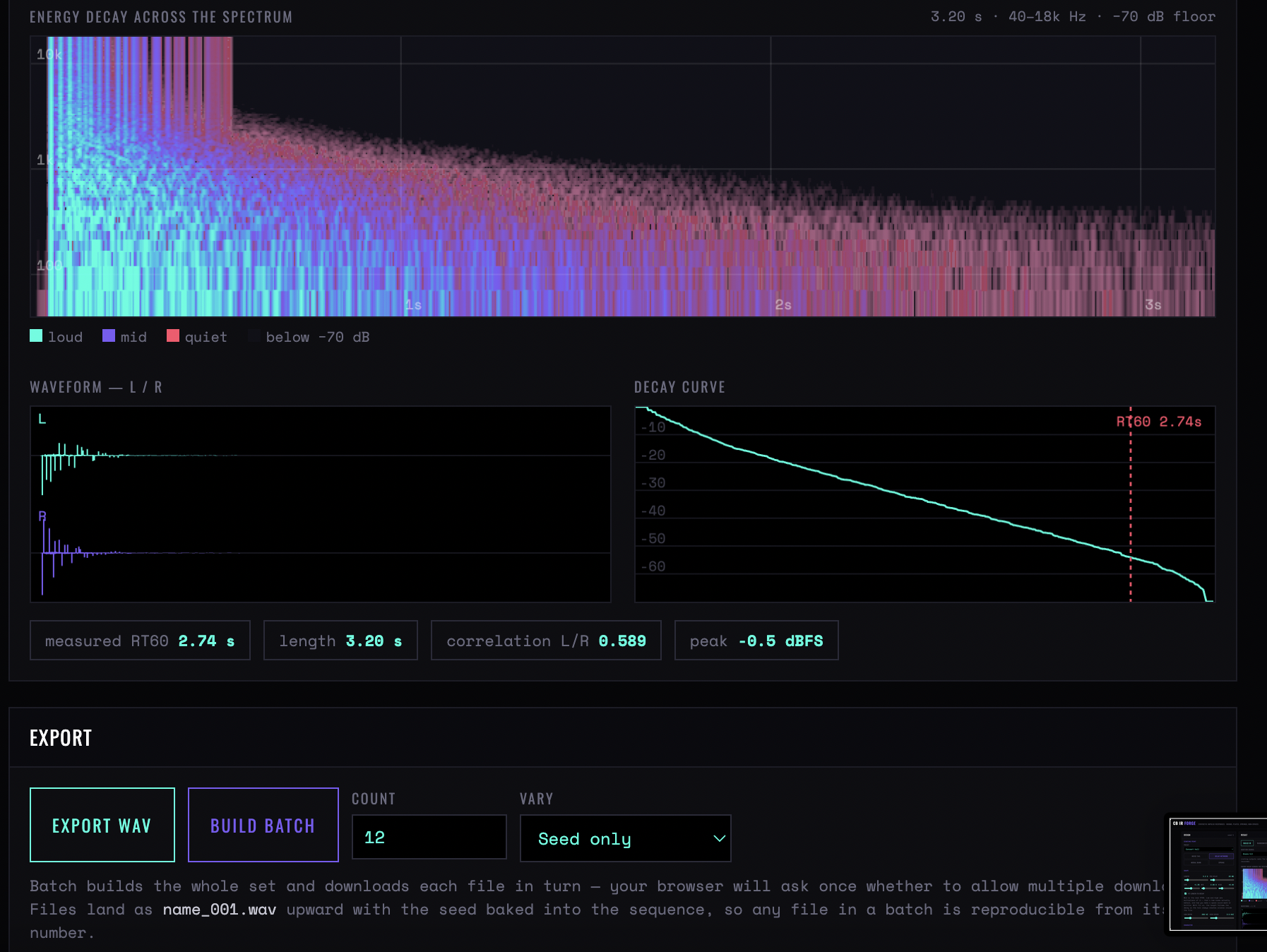
Figure 2 — Shape and character. Mid is the real RT60; low and high are multipliers of it — with fit length to decay on, the file length follows the decay
Chapter two
Shape
How long it lasts and how the length differs across the spectrum. This is the part that decides whether an IR sounds like a real place.
Length
Total duration of the file. Longer than the decay is wasted; shorter truncates the tail and produces an audible cut.
Pre-delay
Silence before the reverb begins. Twenty to forty milliseconds keeps a source distinct from its space — the single most effective control for a reverb that does not swamp a mix.
Mid decay
The real RT60, in seconds. This is the number that answers “how long is the reverb”.
Low / High
Multipliers of the mid decay, not times of their own — which is how rooms actually behave. Low above one and high below it is a warm space; the reverse is brittle. ×1.35 and ×0.40 is a convincing hall.
Fit length to decay
Sets the file length to whatever the longest decay needs. Press it after adjusting the decays and before building.
Low / High xover
Where the three bands divide. 250 Hz and 3.5 kHz are sensible; move the high crossover down to make the darkening more obvious.
Chapter three
Character
Six controls that decide what the tail is made of rather than how long it lasts.
Density
How many reflections per second. Low density is grainy and individual; high density is smooth and continuous. Small rooms are dense, large halls less so — counter-intuitive, and audible.
Diffusion
How evenly the reflections are spread. Low diffusion leaves discrete echoes audible in the tail, which is right for a hard-surfaced room and wrong for a hall.
Tone tilt
Spectral slope in dB per octave. Negative darkens. This does the broad-brush colouring; the per-band decays do the detail.
Width
Stereo decorrelation. Full width is impressive alone and can make a mono source feel unanchored. Check the correlation figure in the result panel.
Inharmonicity
On the modal engine, how far the resonances are pushed off a harmonic series. At zero the reverb is tuned; pushed up it is metal.
Modulation / Dispersion
Slow movement in the tail, and frequency-dependent delay. Modulation stops a long tail sounding static; dispersion is what makes a spring sound like a spring.
Chapter four
Early reflections and envelope
Include early reflections
Adds discrete early reflections before the diffuse tail. They carry the sense of room size — an IR without them sounds like a reverb, one with them sounds like a place.
Room size
The dimension the early reflections are calculated from, in metres. It changes their timing, not the decay length.
ER level
How loud they are relative to the tail. Around −9 dB is natural; louder reads as a small hard room.
Natural decay
The tail falls away. The default and the only realistic option.
Reverse
Swells into the hit. A production effect, not a space, and best kept short.
Gated
Hard cut after a set time. The eighties drum sound, and genuinely useful for making a big space usable on a dense mix.
Bloom
Slow rise, long fall. For pads and sound design, where the reverb is the sound rather than the treatment.
Gate time
Where the gate closes, in milliseconds. Three hundred is the classic; shorter reads as a slap, longer stops reading as a gate at all.
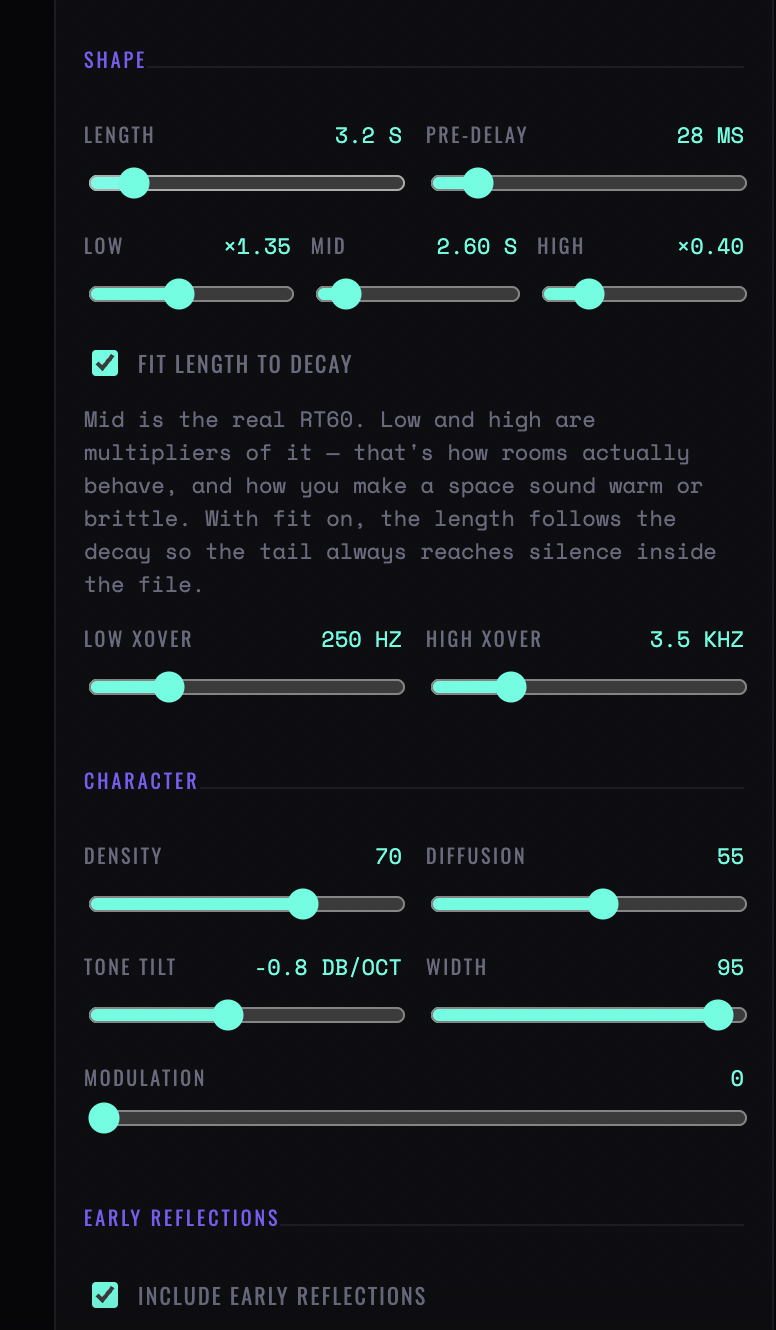
Figure 3 — The result panel: spectral decay, the two channel waveforms, the decay curve with its measured RT60, and the four figures — RT60, length, L/R correlation and peak
Chapter five
Output, seed and result
Sample rate / Bit depth
Match the session the IR will be used in. 24-bit is standard; 32-bit float only if the convolution host prefers it.
Seed
Every random decision in the build comes from here. The same seed and settings give the same IR exactly. Randomize seed for a different one of the same character — this is how you make a matched set.
File name
Used for the single export and as the stem for a batch.
Energy decay
The spectrogram, from loud through mid and quiet to below −70 dB. Read it to see the per-band decays doing their work: the top of the image should vanish before the bottom.
Waveform L / R
The two channels. Visibly different traces mean real stereo width; near-identical ones mean the width control is doing nothing.
Decay curve
With the measured RT60 printed. Compare it against what you asked for — the engine cannot always deliver a stated decay at a stated length, and this is where that shows.
Correlation L/R
How similar the channels are. Near 1 is effectively mono; near 0 is very wide. Below zero the channels partly cancel when summed, which is a fault in anything intended for broadcast.
Chapter six
Batches
The feature that makes Forge worth using over hunting for a preset.
Count
How many IRs to build. Files are numbered from the file name — name_001.wav upwards.
Seed only
Same character, different detail. The right choice for a set of variations on one space — several takes of the same room.
Seed + length
Adds length variation, giving a family from short to long. The most useful batch for a library.
Seed + tone
Varies the tilt, giving bright to dark versions of the same space.
Everything
Wide variation. Useful for generating material to audition rather than a coherent set — expect to keep one in five.
Auditioning honestly
The audition sources — click, snare, plucked tone, noise burst — exist because an IR judged on a bare click is judged wrong. A tail that sounds beautiful on a click is often far too long on a snare. Audition on the noisiest source you can and the IR will survive a real mix.
The audition sources — click, snare, plucked tone, noise burst — exist because an IR judged on a bare click is judged wrong. A tail that sounds beautiful on a click is often far too long on a snare. Audition on the noisiest source you can and the IR will survive a real mix.
CB Sounddesign · IR ForgeOperator's manual · v1.0